

From trial to priority: how St. Antonius Hospital Nieuwegein uses SAM® to tackle outbreaks
To celebrate Loop Robots' fifth anniversary, we're looking back with some of our customers on their experience with SAM. This time, we spoke with St. Antonius Hospital, which began using the disinfection robot in early 2023. What started as an effort to cut chlorine use has become a key part of the hospital's approach to infection prevention and outbreak control.
In January 2023, St. Antonius Hospital introduced SAM at its Utrecht location, led by Wenny Braam, Head of Cleaning Services. The goal was clear: reduce chlorine use. The Nieuwegein location soon followed, where Christiaan van der Burg, Cleaning Team Lead, oversees SAM's day-to-day use.
Christiaan was closely involved in the move from traditional chlorine disinfection to working with SAM. The robot itself proved easy to use. “After shadowing a colleague for an afternoon, almost anyone can operate it on their own. It's simple: switch it on, close the door and let SAM do its job. But in practice, it takes more than just technical know-how.”
Change starts with trust
Introducing SAM meant more than a new way of disinfecting; it also required a shift in mindset. Staff were used to chlorine: its familiar smell was part of the routine of every terminal clean, and the work was done entirely by hand. SAM changed that. The robot takes over part of the work, so the cleaner's role shifts partly from doing to checking. “It didn't happen overnight,” says Christiaan. “I'd only just taken on the role of team lead, and I asked myself more than once: how are we going to make this work? Is this right for us? And isn't this far too busy a time to introduce something new?”
The transition took time and structure. The new way of working was rolled out step by step: first with a small group of colleagues, then across the wider team. SAM was built into standard procedures. For example, the team agreed that every room with a red isolation card would be disinfected with SAM, so it never came down to personal preference.
Reflection also played a big part in this phase. Each week, the team reviewed how SAM was being used: how many disinfections had been done, what was going well and what wasn't yet? If a terminal clean had been missed, they discussed why and how to prevent it next time. This created a learning culture in which the process was constantly refined.
“Those weekly check-ins helped us enormously,” says Christiaan. “You look back together and see what's working and what could be better. That builds trust, not just in SAM, but in each other. Everyone knows why they're doing it.”
Gradually, familiarity, structure and trust grew. “I even noticed that some people suddenly didn't mind walking a bit further to fetch SAM,” Christiaan says with a smile. “That really says it all. What felt new at first slowly became routine.”
The Infection Prevention team valued this careful approach too. For Bram Ophorst*, from the Infection Prevention team at St. Antonius, the biggest difference is consistency: “A cleaner working with chlorine does their very best, but never disinfects exactly the same part of the room – it's a different eighty percent every time. SAM consistently disinfects ninety to ninety-five percent, and you know exactly which five percent it hasn't reached.”
A near-outbreak becomes a turning point
That approach proved its worth during a tense period earlier this year. VRE, a resistant bacterium that spreads mainly via surfaces, was circulating in the region, and St. Antonius was also admitting patients carrying it. Pressure was rising, and extra hygiene measures were needed.
“That could have had a huge impact on the hospital,” says Christiaan. “Extra hygiene measures don't just cause a lot of disruption; they also mean high costs and lost capacity.”
This was exactly when the investment in knowledge and teamwork paid off. Because Christiaan had guided his team step by step, everyone knew exactly what to do. Infection Prevention had been somewhat hesitant at first, but they had seen how the team had grown and how much structure was now in place. That gave them the confidence to tackle the looming outbreak with SAM.
Bram recognizes this: “UV-C itself isn't a new technology; labs have used it for years, for example to disinfect incubators. But using it in patient rooms in a hospital was new to us. By carefully testing where the light does and doesn't reach, we built confidence in both the equipment and the process.”
“That was a key moment,” says Christiaan. “Trust has to grow: first within your own team, then with the people around you. Because we'd built it together, everyone felt confident enough to really rely on SAM when it counted.”
This meant the hospital could act fast, and the decision was made to temporarily rent a second SAM. It proved decisive: with two robots, the team could run far more disinfection cycles than would ever have been possible with manual chlorine cleaning. The outbreak was soon under control, and the experience got everyone on the same page: they had all seen what SAM could deliver.
Christiaan clearly remembers what made the difference. “Without SAM, we'd have had to bring in a lot more staff or fall back on fogging,” he says. “Then a room is out of use for at least three hours. With SAM, it's thirty minutes. That's a huge difference, especially when beds are in high demand.”
Looking ahead with confidence
It was during the outbreak that the team really saw what the robot meant in practice. The contrast with the past suddenly became tangible: where disinfecting so many rooms by hand would have been almost impossible, the team could now stay ahead. As soon as a room was ready, SAM got straight to work, freeing up the team to focus on pre-cleaning and other tasks. In just ten hours, 46 rooms were fully disinfected. Staff still talk about it. “If we'd had to do this with chlorine…” has become a familiar line among the team.
The teamwork between cleaning staff and SAM was especially clear during the outbreak, but daily terminal cleans also show how well they complement each other. While SAM handles disinfection, staff can focus on pre-cleaning and checks. As a result, patient rooms are turned around faster and to a high standard. That directly supports patient safety and continuity of care, especially when beds are in high demand.
“By using SAM smartly, we finish terminal cleans faster,” says Christiaan. “But more importantly, we know for sure that the room is properly clean before the next patient arrives. That means we can help more patients, with peace of mind.”
Reliability and service are key here. As long as SAM keeps running smoothly, the team can work consistently, without delays or added pressure. According to Christiaan, the robot has never been out of action for more than a day. If something goes wrong, the team can contact Loop Robots directly, and nine times out of ten the problem is solved right away. Thanks to clear instructions and support, the team can often fix minor issues themselves. That reliability builds trust and has made SAM a fixed part of everyday work.
Bram also sees clear benefits for monitoring and accountability: “After every disinfection, SAM produces a report with a floor plan showing exactly where the robot has been. So we can always go back and check whether a room was actually disinfected. That makes it a reproducible, verifiable process.”
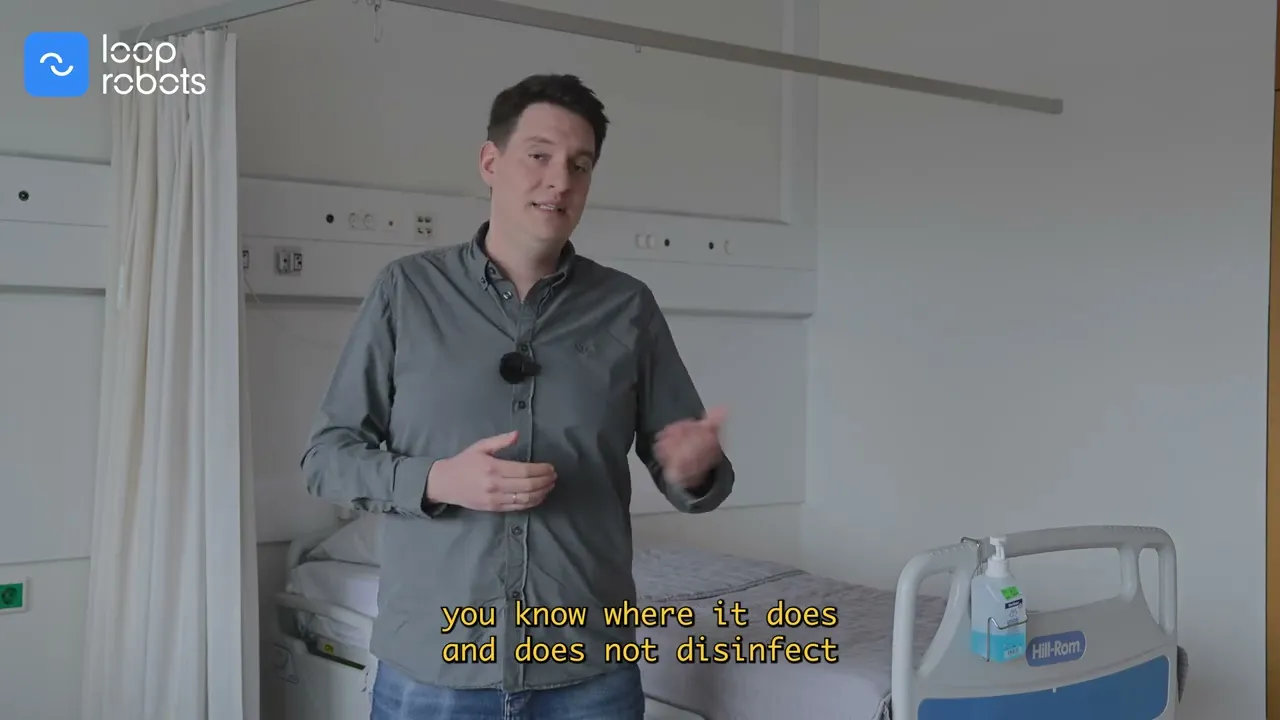
Together, experience, reliability and more efficient use of SAM showed how much potential is still untapped. The VRE period made clear what the robot can do when it really counts. That's why St. Antonius is now working towards having two SAMs permanently at its Nieuwegein location. This will give the hospital more flexibility, let it cover a wider area and also use SAM preventively. The result: faster response to incidents and even shorter turnaround times for patient rooms.
An invitation to other hospitals
Christiaan hopes his story will show hospitals that are just starting out that improvement only begins when you dare to take the first step. Change takes time, but without that first step, you don't get anywhere. “As a team lead, you have to keep inspiring and motivating people,” says Christiaan. “You have to bring them along with you, even when things get bumpy. You only really make a difference by doing it and sticking with it.”
For him, it's about more than technology. His advice: be clear about your policy and don't offer alternatives for specific isolation types. That's the only way to build routine and make SAM a real part of the process.
Curious to see SAM in action? Christiaan would be happy to welcome you for a visit in Nieuwegein.
*At the time of this interview, Bram Ophorst was involved in infection prevention at St. Antonius Hospital. He now works at Meander Medical Centre.
Posted in
Related Posts


Want to know more?
